
Island Health is committed to making a positive contribution to environmental sustainability and supporting community preparedness and resiliency for climate emergencies.
Climate change is one of the greatest threats to human health and to our vision of providing excellent health and care for everyone, everywhere, every time. People in our region are already experiencing the effects of climate change through more frequent and severe weather events, including extreme heat, wildfires, drought, and flooding. These conditions affect our health and well-being, making climate change a critical health concern.
We are taking action by reducing greenhouse gas (GHG) pollution, adopting more sustainable health care practices, and strengthening our resilience to a changing climate. Our vision is to create a climate-resilient health system that demonstrates excellence in sustainability and upholds its responsibility to planetary health.
Climate change and planetary health strategy
Climate change and planetary health strategy coordinates efforts across the organization toward a shared purpose, vision, and goal for climate action. By applying a planetary health lens to our work, we can address climate change alongside the social and environmental factors that influence health, while improving the quality of care.
The four pillars of our strategy are:
-
Improving the climate resiliency, adaptability, and environmental sustainability of our health-care services
-
Creating a culture of coordinated and effective climate action
-
Building sustainable and climate-resilient healthcare infrastructure and operations
-
Building a shared path with partners and communities toward climate resilience
Read the Climate Change and Planetary Health Strategy.
Targets and progress
Greenhouse gas emission reduction target aligns with the Province of British Columbia’s Carbon Neutral Government (CNG) reporting program and CleanBC public sector climate commitments.
Through the CNG program, Island Health has achieved carbon neutral operations since 2010 through the purchase of high-quality, made-in-B.C. carbon offsets.
| Focus area | 2030 goal | Latest progress |
|---|---|---|
|
Reduce greenhouse gas emissions from:
|
50% reduction by 2030 (2010 baseline) | 13.9% reduction achieved as of 2025 |
The 2025 Climate Change Accountability Report provides an overview of Island Health's progress towards sustainability goals. The report also features real-life stories to illustrate collective progress towards our vision of a climate-resilient health system.
Reducing environmental impacts
We’re working hard to minimize our environmental footprint and build sustainability into day-to-day operations.
Explore the highlights below.
- Energy
-
Since 2008, Island Health’s Energy Management Program has led projects to improve building energy efficiency, incorporate cleaner energy, and operate our buildings with smarter controls.
We have reduced building emissions by 19 per cent since 2010, while expanding our floor space by 22 per cent. This means we're using energy much more efficiently. Our emissions per square meter of floor space has dropped significantly, from 0.065 tonnes of CO₂ equivalent per square meter in 2010, to 0.045 in 2023.
BC Hydro and FortisBC continue to be strong partners in our journey to improve energy efficiency and reduce greenhouse gases. To learn more about our progress, see our annual Strategic Energy Management Plan.
Island Health’s Low Carbon Resilience Roadmap is our capital infrastructure plan to reach a 50 per cent reduction in greenhouse gas emissions by 2030 and an 80 per cent reduction by 2050. The roadmap focuses on reducing fossil fuel use in our buildings by improving building systems, adding energy-saving upgrades, and using electric and renewable energy options. Upgrades will also enhance indoor air quality, provide better cooling, improve electrical capacity, and reduce water consumption.
The roadmap uses a variety of technologies and strategies to achieve our emissions targets. Our approaches include:
- Control optimization and upgrades: Working closely with our facility operators to fine-tune our building systems. For example, adjusting air circulation rates to avoid wasting energy. This is our top priority because it delivers clear benefits with low costs.
- HVAC and heat recovery upgrades: We can capture waste heat from building exhaust and medical imaging devices to reduce natural gas usage.
- Thermal energy storage: Allows us to store heating or cooling energy for use later, which can boost building capacity without increasing electrical demand. Options include geo-exchange and ice storage.
- District energy: District energy systems supply energy to multiple buildings from a central plant, often in urban areas. This setup is efficient, climate-resilient, and can use low-carbon sources like biomass, electricity, and renewable natural gas (RNG). Learn more about the new energy centre set to begin construction in Summer 2026 at Victoria General Hospital.
- Fuel switching: Fuel switching involves replacing high-emission fuels like natural gas, diesel, and oil with cleaner options. Our main goal is to shift to electric energy, since B.C.’s grid is mostly renewable hydroelectricity. Where electrification isn’t possible, we’ll consider renewable natural gas, and for remote sites, biomass where feasible.
Read the full Low Carbon Resilience Roadmap report here.
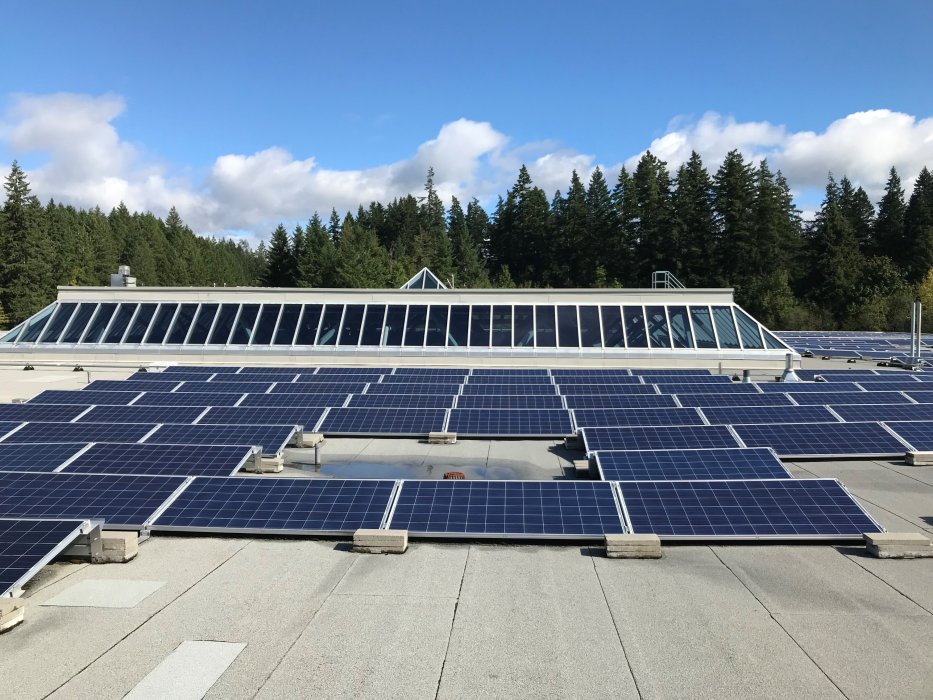
West Coast General Hospital's rooftop solar array. Solar energy: West Coast General Hospital in Port Alberni has one of Vancouver Island's largest rooftop solar photovoltaic systems. The rooftop's 400 solar panels supplement the hospital's electricity, particularly on hot summer days when air conditioning is needed. Island Health also installed solar hot water systems at Victoria General, Saanich Peninsula Hospital, Aberdeen Hospital, and Cairnsmore Place in Duncan in 2011. The thermal systems reduce our use of natural gas.
- Facility design
-
All new hospitals must be built with “Leadership in Energy and Environmental Design” (LEED) principals and meet LEED Gold certification.
Island Health currently has four LEED Gold facilities:
• North Island Hospital, Campbell River & District campus
• North Island Hospital, Comox Valley campus
• Patient Care Centre at Royal Jubilee Hospital in Victoria
• Emergency Department at Nanaimo Regional General Hospital
Island Health has one LEED Silver facility (Oceanside Health Centre in Parksville).
The new Quw'utsun Valley Hospital / Quw'utsun Hulitun-ew't-hw, set to complete in 2027, will be Canada's first carbon-zero hospital and B.C.'s first all-electric hospital. The new hospital will be more than three times larger than the current Cowichan District Hospital, but emit 75 per cent less greenhouse gas emissions and use 60 per cent less water.
- Clinical care
-
Island Health clinicians are leading the way in integrating a planetary health lens into patient care, finding innovative solutions that improve patient outcomes while reducing environmental impact.
Highlights include:
Choosing Wisely: Choosing Wisely Canada (CWC) is a national initiative that advocates to reduce overuse through promoting dialogue on avoiding unnecessary tests, treatments, and procedures. Choosing Wisely is leading the vital work of embedding climate-conscious decision-making across Island Health and we were recognized as a CWC Hospital at Quality Improvement status in 2024. Learn more about Choosing Wisely at Island Health here.
Renal care: Kidney care is a key sustainability focus area due to the adverse environmental impact of treatments, which in turn impact health outcomes and vulnerabilities for people living with kidney disease. Kidney care specialists at Island Health are leading work to reduce these impacts, in partnership with BC Renal.
Respiratory care: The Critical Air Project, led by Dr. Valeria Stoynova and Dr. Celia Culley, identified opportunities to reduce inhaler related GHG emissions in in-patient settings by combatting inhaler waste and loss. The project takes a multi-pronged approach to understand the case for change before enacting shifts in policy (e.g., drug formulary listings, medication discharge procedures) and operations. Learn more about the Critical Air Project here.
Virtual care: Patients can reduce travel time, costs, and emissions using technology, which virtually connects patients to health care services. Virtual Care aims to create a similar experience to in-person consultation, where available. In addition, Island Health’s adoption of BC Virtual Visit has helped patients avoid more than 23 million kilometres in travel and save more than $4.4 million in travel costs since 2020. These efforts have also saved more than 2,600 tons of greenhouse gas emissions. Read the full story here.
- Materials and waste
-
The materials we use every day in health care, from PPE and medications to lab equipment and packaging, have an environmental impact at every stage of their life cycle. We’re working hard to steward resources responsibly, cut landfill waste, and support the circular economy.
Highlights include:
Reusable gowns: Island Health launched its Reusable Level 2 Isolation Gowns Program in 2025. These gowns are worn by staff when there are risks of infection transmission, such as when patients are on isolation precautions. The new reusable gowns generate 30 per cent less greenhouse gas emissions, consume 41 per cent less water, and create up to 99 per cent less solid waste over their life cycle compared to their single-use counterparts. They also exceed industry standards for wearer protection and are up to 80 per cent more cost effective than single-use disposable gowns. Usage is tracked with RFID chips that count the number of times each gown is washed, and the gowns are recycled after 100 uses. Learn more about the reusable gowns program here.
Furniture reuse: Island Health’s Royal Jubilee Hospital offers hundreds of lightly-used desks, chairs, office storage, televisions, and medical furniture – all free for staff. Island Health staff are encouraged to opt for used furniture and equipment through the surplus showroom when moving or updating their office spaces.
Reusable laundry bags: Island Health’s in-house laundry services transitioned from disposable plastic bags to reusable mesh bags for the transportation of clean linens to our sites. Over 600 mesh bags are now shipped daily from Victoria Regional Laundry and 300 from Cumberland Regional Laundry. The change has eliminated over 100,000 single-use plastic bags per year.
Paper: Island Health’s standard letter‑sized paper is Sugar Sheet, a low-emissions paper made from sugarcane waste byproducts. In 2024, over 90 per cent of copy paper purchased was Sugar Sheet. This shift reflects the success of strategies to promote lower emission alternatives and aligns with longer‑term declines in overall paper use.
Office supplies: Island Health provides a Sustainable Office Supplies Purchasing Guide to help staff make informed, sustainable choices when ordering office supplies. The guide includes a curated list of recommended products, suggestions for cutting delivery emissions and fees, and information on office supply recycling programs.
Personal Protective Equipment (PPE) Recycling Program: Island Health’s Utilization and Resources team launched Island Health’s PPE recycling program in June 2024 in partnership with PHSA, Vitacore, and Staples. Since the program launch, 664 PPE recycling bins were installed in seven acute care sites, with more than 50 tonnes, or 5.8 million pieces, of PPE recycled as of March 2025.
- Food
-
Island Health Food Services is proud to serve meals to 1,480 acute-care patients and 1,709 long-term care residents each day, while working to deliver on commitments to planetary health.
Supporting B.C. Food producers: Island Health Food Services spends over 31 per cent of its food budget supporting local farmers, fishers and food processors in B.C. – exceeding provincial FeedBC targets.
Reducing food waste: Island Health Food Services is proud to be partnered with social enterprise Goodly Soups. The local Vancouver business transforms surplus or “imperfect” produce into soups, stocks, and stews – turning potential food waste into nutritious meals.
Reducing plastic waste: Island Health Food Services is transitioning from disposable to durable dishes, replacing single use bowls and lids across the region. Our South Island acute-care hospitals divert 100,000 disposable plastic plates each year, from a switch to custom-made reusable plates for patient meals. The new reusable plates stack, store, re-heat and divert significant waste from landfill.
Reducing paper waste: New electronic health records have allowed Island Health Food Services to eliminate additional paper copies by reducing the need to fax. This change cut paper consumption by half, saved staff time, and reduced communication delays.
- Water
-
Island Health is working to use water more efficiently and reduce water waste. Our goal is to use 20 per cent less water for every square metre of building space by 2030. To date, the organization has achieved an 8 per cent reduction from 2010 levels.
Highlights include:
- All new facilities are built to high water efficiency standards through LEED Gold certification. For example, the new Quw’utsun Valley Hospital, set to complete in 2027, will be 60 per cent more water efficient than the previous hospital.
- Staff are encouraged to adopt mindful water use habits, choose water-efficient fixtures and appliances, and report leaks as soon as possible. Water-smart practices are championed by local Green Teams and by sustainability education available to all staff.
- Transportation
-
We’re taking action to reduce climate impacts from transportation.
Highlights include:
Fleet emissions: Island Health is transitioning its fleet to low and zero-emission vehicles and is implementing strategies to improve fuel efficiency for current gas and diesel vehicles. The health authority is committed to a 40 per cent reduction in fleet emissions by 2030, and to the CleanBC provincial mandate by making 10 per cent of light-duty vehicle replacements zero-emission vehicles. Island Health currently owns and operates 29 EVs, 6 PHEV, and 10 hybrid vehicles.
Charging stations: Island Health provides public EV charging to meet municipal requirements or achieve LEED points for new construction. Currently, Island Health owns and operates twenty-seven Level 2 charging stations.
Sustainable commuting: Island Health supports sustainable commuting by providing 1,388 onsite bike parking spaces, including 186 secure bike lockers and bike cages for staff. The organization also participates in the BC Transit ProPASS program, which offers heavily discounted transit passes to eligible staff in the Greater Victoria, Nanaimo, Comox Valley, and Cowichan Valley transit regions.
- Staff engagement and education
-
Green Teams Program: Green Teams help turn staff ideas into real, on‑the‑ground climate action. These voluntary teams work within their workplaces to identify practical ways to reduce waste, cut pollution, and strengthen climate resilience. By joining the Green Teams Program, teams receive hands‑on project guidance, learning opportunities, and access to tools and resources, and join a community of practice to build skills and career‑relevant experience. As of April 2025, Green Teams have led over 40 unique sustainability initiatives.
Green Operating Rooms Program: Operating rooms (ORs) are among the most energy and resource-intensive areas in health care, and sustainability improvements in these environments can strengthen patient safety, quality, and efficiency. The Green ORs Program provides surgical care teams with evidence-based tools, education, and hands-on guidance to help turn ideas into action. Results include improved recycling workflows, increased use of safe and effective reusable supplies, and significant reductions in the use of desflurane, an anesthetic gas that contributes to climate change.
Climate-Resilient Island Health e-Learning Course: Climate-Resilient Island Health is an e-learning series designed to help our staff and medical staff understand how their work connects to Island Health’s climate change response. Launched in December 2025, this four-module course explores how climate change affects health and health care operations in the Island Health region. It highlights practical, role-appropriate climate actions that respect staff time, expertise, and capacity.
Planetary Health Awards: Island Health hosts its annual Planetary Health Awards program to recognize staff and medical staff leading meaningful work to advance environmental sustainability and climate resilience. The awards celebrate the many ways sustainability shows up in day‑to‑day health care work, through staff-led efforts to reduce single‑use plastics, improve energy efficiency, maintain healing gardens, and improve access to care during wildfires and heat waves.
Climate Change & Planetary Health Conference: This September 2024 event brought together more than 200 staff, medical staff, and leaders from across the organization to focus on our ambitious climate journey. Attendees gained valuable insights into ongoing sustainability work and Island Health's future direction. The event featured breakout sessions focused on creative healthcare waste solutions, water conservation, and adopting sustainable clinical care practices.
Strengthening climate resilience
The health system must be prepared to deliver care and support community health in a changing climate.
Extreme weather can stress the health system through increased patient loads, damage to facilities, new occupational health risks, or supply chain interruptions. We can greatly reduce these risks by planning ahead and preparing for climate-related emergencies.
B.C.’s Climate Preparedness & Adaptation Strategy provides overall direction for this work, outlining key pathways to prepare for a changing climate.
- Resilient facilities
-
Vulnerability assessments: Island Health conducts a range of assessments across our building portfolio, to identify climate change vulnerabilities and act on them. For example, Nanaimo Regional General Hospital was the first hospital in Canada to complete a PIEVC Climate Change Vulnerability Assessment.
We apply the following tools to enhance resilience at our facilities:
- Climate Resilience Guidelines for BC Health Facility Planning and Design
- Climate Change Extreme Event Screening Tool for Projects
- Contract Addendum: Designing for a Changing Climate
Low-Carbon Resilience Roadmap: In 2024, Island Health released its Low Carbon Resilience Roadmap, our capital infrastructure plan to reach a 50 per cent reduction in greenhouse gas emissions by 2030 and an 80 per cent reduction by 2050. This roadmap will also improve our buildings' resiliency to extreme heat, drought, and wildfire smoke. For example, planned capital improvements will:
- Add 3,600 tons of extra cooling capacity across our sites.
- Provide better air quality through upgraded filters and air recirculation systems, which are crucial as wildfires and smoke become more common.
- Improve water efficiency by replacing or avoiding water-intensive equipment like cooling towers.
New construction: Island Health’s Major Capital and New Construction division ensures new facilities are designed, constructed, and begin operations with minimal emissions impacts. The team advises on optimal ways to build and reconfigure our hospitals and clinics for climate resilience.
For example, the new Quw'utsun Valley Hospital, set to complete in 2027, will feature advanced ventilation and filtration systems to support cleaner air, benefiting people with respiratory conditions such as asthma and COPD and providing greater operational resilience during wildfire smoke events. It will also be 60 per cent more water-efficient than the current hospital, which is important for increased summertime drought.
- Resilient communities
-
The health system plays an important role in helping communities prepare for climate change and adapt to the health impacts. By building on existing strengths and addressing local vulnerabilities, we can create broad-based resilience to climate change that is fair, inclusive and makes us less prone to disruption in the long term.
For example, Environmental Health Officers work with local water system operators to ensure emergency response and contingency plans are in place to respond to drought. Island Health’s Population and Public Health teams also provide education and guidance to help people prepare and respond to environmental health risks like extreme heat, wildfire smoke or drought.
Because the Island Health region has diverse populations and geographies, we take a community-based, holistic systems approach to supporting communities within the region. We can support by:
- Providing evidence on how climate change affects health
- Helping communities plan and prepare for climate-related health risks
- Supporting emergency preparedness for climate-related health impacts
- Sharing knowledge and building capacity through community engagement and empowerment
- Partnering with Indigenous Peoples to support shared climate goals
You can read more about our approach to climate resilience and how we can help in our document Strengthening Health and Resilience in a Changing Climate: A Primer for Local Governments.
Let's connect
Sustainability is a shared effort across many teams working together at Island Health. We’re proud to have a growing community of staff and medical staff who are advancing environmental sustainability in their practices, leading research and advocacy, and working to protect our local communities from the damaging effects of climate change.
Island Health also works with community partners such as local and provincial governments, utility partners, First Nations and Indigenous organizations, schools and postsecondary institutions, and more.
Reach out at sustainability@islandhealth.ca to connect.